


A kitchen bin may be simple equipment, but fitting one inside cabinetry can become a small space-planning exercise. Sinks reduce available height, plumbing occupies depth and hinges can interfere with moving mechanisms.
Before comparing kitchen bins, homeowners should inspect the intended cabinet with the doors open and measure the space that can genuinely be used.
Map the Obstacles Inside the Cabinet
Start with a sketch of the cabinet.
Mark the position of the sink bowl, waste pipe, water connections, hinges and any existing shelves. This makes it easier to see where a waste container could fit without interfering with services.
A simple drawing is often more useful than one overall width measurement.
Under-Sink Storage Requires Special Attention
under sink bins must work around obstacles that do not exist in a standard cabinet.
Under sink bins may need to sit to one side of the waste pipe or use a lower configuration beneath the sink bowl.
Important measurements include:
- Width beside plumbing
- Available height
- Clear depth
- Door-opening width
- Hinge projection
- Pipe clearance
- Space required to remove the bucket
Consider How the Bin Will Open
A loose container simply sits inside the cupboard. Integrated systems often move.
A pull out bin needs enough space for its runners and full extension.
Pull out bin fit should therefore be evaluated in two positions: fully closed and fully open.
Model the Movement Before Installation
Do not assume empty space will remain empty while the product moves.
Check lids, frames and buckets
Different components may travel through different parts of the cabinet. Pay particular attention to plumbing and door hinges because these commonly reduce usable clearance.
Choose Capacity After Establishing Fit
It is natural to want the largest possible bin, but physical fit comes first.
Once suitable dimensions are established, compare capacities within that size envelope.
Kitchen bins with slightly lower capacity may sometimes provide better access or make room for recycling separation.
Match the Arrangement to Waste Habits
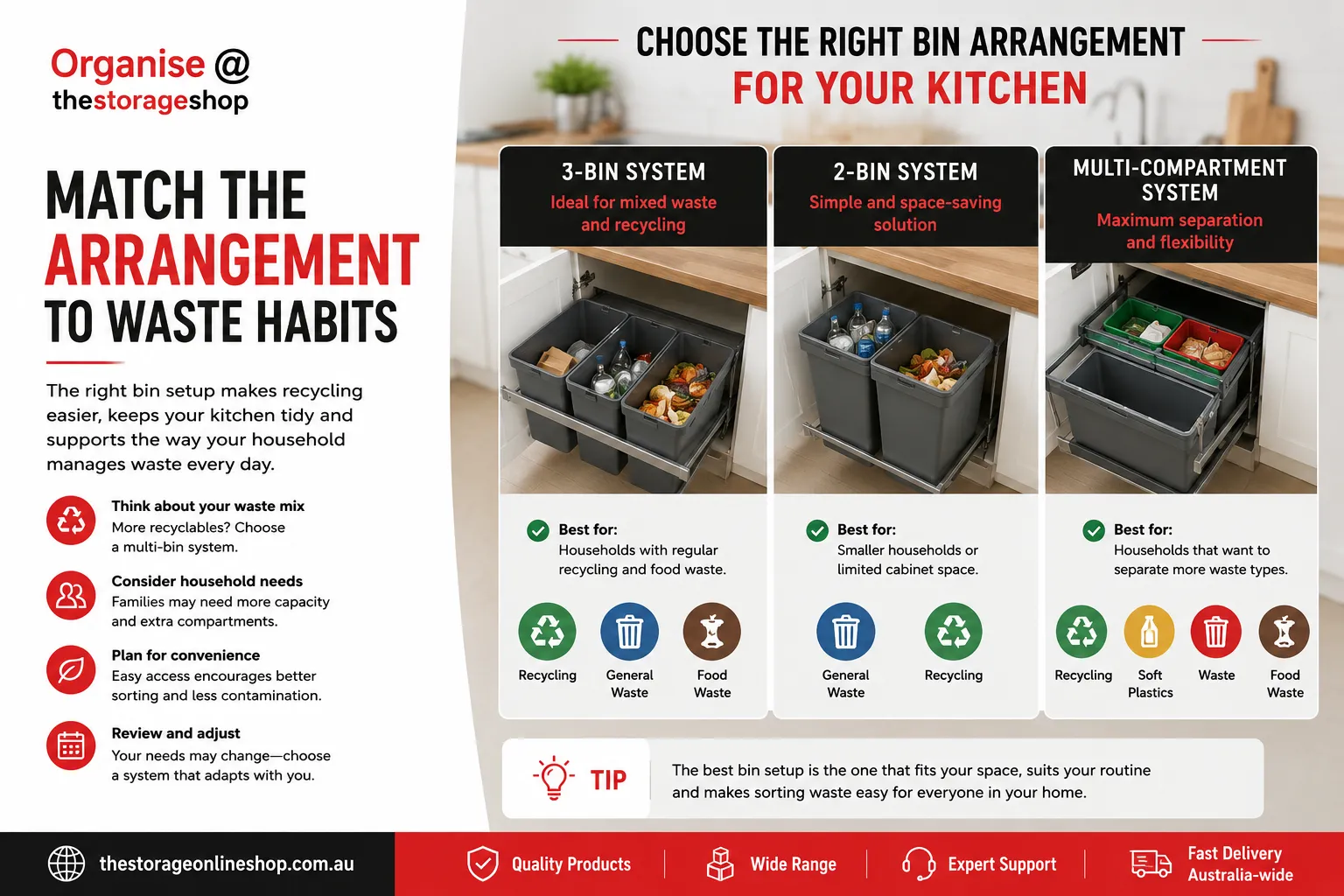
Observe household rubbish for several days.
How quickly does general waste accumulate? How much recycling is generated? Are food scraps handled separately?
These answers can determine whether one larger container or two smaller buckets will be more useful.
Avoid Designing Around Rare Events
Holiday gatherings may produce unusually high waste volumes.
Plan for normal weeks
Choose capacity based on everyday use rather than the largest amount of rubbish the household might produce once or twice per year. Temporary overflow can be handled separately when necessary.
Consider the Sink’s Position
Not every kitchen places plumbing neatly at the back of the cabinet.
Deep sink bowls may extend lower than expected, while centrally positioned pipes can divide the cupboard into two narrow areas.
Under sink bins should be evaluated against this real geometry rather than a generic illustration of an under-sink cabinet.
Protect Access to Plumbing
Integrated storage should not make routine plumbing access unnecessarily difficult.
Choose an arrangement where buckets can be removed without major disassembly. Leaving some working space around key connections can be useful if maintenance is required.
This is especially important in small cabinets where every centimetre tends to be allocated.
Think About the Kitchen Workflow
The best cabinet is not always the nearest available cabinet.
If most food preparation happens on an island, placing the pull out bin under that work area may be more convenient than automatically putting it under the sink.
Consider where waste is generated and how people move through the room.
Make Liner Changes Easy
A full bucket needs to come out comfortably.
Check vertical clearance and the angle required to remove it from the frame. A bin that is difficult to lift out can become frustrating regardless of how neatly it fits when closed.
Why Choose Us
The Storage Online Shop offers kitchen-storage products that allow homeowners to explore integrated waste solutions alongside other cabinetry accessories. Product selection can begin with measurements and the intended cabinet rather than guessing from capacity alone.
This is particularly useful when sink plumbing or a compact layout reduces the available installation area.
About Us
The Storage Online Shop provides practical products for organising kitchen interiors, including waste-storage solutions designed for cabinet use. Homeowners can explore options based on the space available and the way their kitchens function.
For anyone comparing kitchen bins, careful measurement remains the simplest way to narrow products that could realistically suit the cabinet.
Conclusion
A kitchen bin works best when it is treated as part of the cabinetry layout rather than an object added afterwards.
Map the plumbing, measure internal space, check the opening path and choose capacity from the options that genuinely fit. This approach can help create waste storage that remains accessible without compromising important cabinet or sink functions.

